
• Skip to main content
  • Skip to navigation
  • Accessibility
  • Contact Us
Government of Western Australia Crest
Government of Western Australia
Government of Western Australia Crest

Additional Menu

  • Accessibility
  • Contact us
Go to WA Government search
  • For patients and visitors
    • Emergencies
    • Aishwarya's CARE Call
    • Coming to Fiona Stanley Hospital
      • Visiting our hospitals
      • Finding your way
      • Maps
      • Facilities
      • Parking and transport
    • Coming to Fremantle Hospital
      • Visiting our hospitals
      • Map of Fremantle Hospital
      • Facilities
      • Parking and transport
    • Coming to Cockburn Health
      • Visiting our hospitals
      • Parking and transport
      • Maps of Cockburn Health
    • Visiting our hospitals
    • Being a patient
      • Understanding your surgical journey
      • Your hospital admission
      • Understanding where you will receive care
      • During your hospital stay
      • Ordering patient meals
      • Elective surgery
      • Outpatients
      • Private patients
      • Treatment costs for overseas visitors and students
      • Going home from hospital
    • Support during your stay
      • Pastoral care
      • Peer support workers
      • Supporting Aboriginal patients and families
      • Supporting people with disability
    • Keeping you safe
      • Reduce your risk of falls – Be SAFER
      • Preventing pressure injuries
      • About good hand hygiene
      • Preventing healthcare associated infections
    • Managing your health care
      • Patient rights
      • Goals of patient care
      • Talk about 'What matters to you?'
      • MySay healthcare survey
    • Easy read resources
    • For families and carers
      • Pastoral care
      • Supporting carers
      • Supporting Aboriginal patients and families
      • Supporting patients with cognitive impairment
      • Understanding delirium
      • If you can't visit an older patient
      • The intensive care journey
      • After the loss of a loved one
    • Freedom of information
    • Feedback compliments and complaints
  • For health professionals
    • Information for GPs
      • SMHS GP Engage
    • Refer a patient
      • Service specific referrals
    • Library and Information Service
  • Our services
  • Our community
    • Volunteer with us
    • Consumer Advisory Council
    • 'Put it to the People' engagement platform
    • ED Consumer Advisory Group
    • Mental Health Consumer Advisory Group (Fremantle Hospital)
    • Pulse
  • Our research
  • Work with us
    • Career opportunities
      • Aboriginal workforce
      • Allied Health
      • Corporate non-clinical
      • Graduates
      • Medical
      • Mental health
      • Nursing and midwifery careers
    • Fellowships
      • Anaesthesia and Pain Medicine
      • Medical Imaging Fellowships
    • Living in WA
  • News
  • About us
    • About FSFHG
    • About South Metropolitan Health Service
    • Feedback, compliments, concerns and complaints
    • Conduct and standards
    • Contact us
    • Executive
    • Our vision and values
    • Our history
    • Our Aboriginal heritage
  1. Home
  2. Our services
  3. Anaesthesia Pain and Perioperative Medicine
  4. PrepCheck

PrepCheck

Pre-block time-out safety check for peripheral nerve blocks

PrepCheck

PrepCheck logo featuring the words PrepCheck and a tick mark in the letter c for check

PrepCheck is a pre-block time-out process – a simple but highly effective safety check which prevents wrong side nerve blocks. It confirms the correct side and site to be blocked at the moment sterile prep is applied for the block.

An alternative to the ‘Stop Before You Block’ process, it addresses human factors in busy clinical environments where the risk of human error is high.

PrepCheck was developed by regional anaesthesia specialists at Fiona Stanley Fremantle Hospitals Group, part of the broader South Metropolitan Health Service (external site) based in Perth, Western Australia.

Following a successful pilot, PrepCheck is already being used across multiple Perth public hospitals.

PrepCheck supports patient safety

PrepCheck was developed in response to a series of wrong side blocks, where wrong side skin prep, distractions and forgetting to do a formal block check were implicated.

Previous processes delayed the formal block check until final needle insertion (needle-in-hand) which:

  • enabled wrong side skin prep
  • risked task fixation
  • timed the block check at a moment of high cognitive load (after ultrasound scanning).

The simple and intuitive PrepCheck process:

  • ensures the correct site/side is checked from the start
  • improves communication, teamwork and wider staff engagement
  • is compatible with existing theatre checklists, causing minimal disruption to workflow.

How to perform PrepCheck

The three-step process links the actions of skin PREP and block CHECK.

It should involve at least two members of the clinical team, typically an:

  • anaesthetist (referred to as the Blocker)
  • assistant, such as an anaesthetic technician or nurse.

Application of sterile skin prep for the block prompts the Blocker to lead a two-person check of site and side.

Linking these two actions builds the block check into the workflow, making it difficult to skip this essential step.

PrepCheck at a glance

Step Actions How it supports safety

Step 1

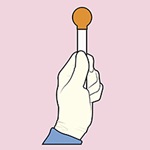
Hold the PREP

Illustration of a hand holding a skin prep applicator

Blocker holds skin prep, assigns an Assistant, and says, “Let’s do a PrepCheck”.

Creates a momentary pause, prompting communication and teamwork.

Acts as an obvious visual and verbal clue to the wider team.

Step 2

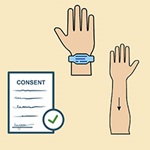
Block CHECK

Three line drawings, from left to right a consent form, a patient identification band on a wrist, and an arm with a surgical mark

Blocker and Assistant (and patient if awake) check:

  • patient and ID band
  • surgical consent
  • surgical mark.
Blocker maintains responsibility for leading process and applying skin prep throughout.
 

Acts as the formal two-person check of block site/side against sources of truth.

Step 3

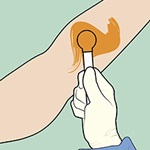
PREP the skin

Complete block

Line drawing of skin prep being applied to the block site or side.


Blocker applies sterile skin prep to the block site/side and completes nerve block.

Repeat PrepCheck if:

  • there is a delay completing the block
  • a distraction away from the block area
  • there is a new block or patient position changes.
 

Acts as a physical and mental commitment to specific block site/side.

Blocker unlikely to insert block needle elsewhere.

Download PrepCheck resources

  • PrepCheck infographic (PDF 482KB)
  • PrepCheck summary document (PDF 416KB)

More information

Learn more about:

  • Anaesthesia, Pain and Perioperative Medicine at Fiona Stanley Fremantle Hospitals Group.
  • Anaesthesia and Pain Medicine Fellowships and Senior Registrar Positions
  • Stop Before You Block (external site)

Contact us

Email PrepCheck


Return to main Anaesthesia, Pain and Perioperative Medicine page

Last Updated: 23/09/2026
  • Facebook
  • LinkedIn

Footer menu

  • wa.gov.au
  • Copyright
  • Disclaimer
  • Privacy
  • Sitemap
  • Contact Us

Brought to you by the Department of Health, Western Australia

© Government of Western Australia 2018 to