
• Skip to main content
  • Skip to navigation
  • Accessibility
  • Contact Us
Government of Western Australia Crest
Government of Western Australia
Government of Western Australia Crest

Additional Menu

  • Accessibility
  • Contact us
Go to WA Government search
  • For patients and visitors
    • Emergencies
    • Aishwarya's CARE Call
    • Coming to Fiona Stanley Hospital
      • Visiting our hospitals
      • Finding your way
      • Maps
      • Facilities
      • Parking and transport
    • Coming to Fremantle Hospital
      • Visiting our hospitals
      • Map of Fremantle Hospital
      • Facilities
      • Parking and transport
    • Coming to Cockburn Health
      • Visiting our hospitals
      • Parking and transport
      • Maps of Cockburn Health
    • Visiting our hospitals
    • Being a patient
      • Understanding your surgical journey
      • Your hospital admission
      • Understanding where you will receive care
      • During your hospital stay
      • Ordering patient meals
      • Elective surgery
      • Outpatients
      • Private patients
      • Treatment costs for overseas visitors and students
      • Going home from hospital
    • Support during your stay
      • Pastoral care
      • Peer support workers
      • Supporting Aboriginal patients and families
      • Supporting people with disability
    • Keeping you safe
      • Child safeguarding
      • Reduce your risk of falls – Be SAFER
      • Preventing pressure injuries
      • About good hand hygiene
      • Preventing healthcare associated infections
    • Managing your health care
      • Patient rights
      • Goals of patient care
      • Talk about 'What matters to you?'
      • MySay healthcare survey
    • Easy read resources
    • For families and carers
      • Pastoral care
      • Supporting carers
      • Supporting Aboriginal patients and families
      • Supporting patients with cognitive impairment
      • Understanding delirium
      • If you can't visit an older patient
      • The intensive care journey
      • After the loss of a loved one
    • Freedom of information
    • Feedback compliments and complaints
  • For health professionals
    • Information for GPs
      • SMHS GP Engage
    • Refer a patient
      • Service specific referrals
    • Library and Information Service
  • Our services
  • Our community
    • Volunteer with us
    • Consumer Advisory Council
    • 'Put it to the People' engagement platform
    • ED Consumer Advisory Group
    • Mental Health Consumer Advisory Group (Fremantle Hospital)
    • Pulse
  • Our research
  • Work with us
    • Career opportunities
      • Aboriginal workforce
      • Allied Health
      • Corporate non-clinical
      • Graduates
      • Medical
      • Mental health
      • Nursing and midwifery careers
    • Fellowships
      • Anaesthesia and Pain Medicine
      • Medical Imaging Fellowships
    • Living in WA
  • News
  • About us
    • About FSFHG
    • About South Metropolitan Health Service
    • Acknowledgement of Country
    • Feedback, compliments, concerns and complaints
    • Conduct and standards
    • Contact us
    • Executive
    • Our vision and values
    • Our history
    • Our Aboriginal heritage
  1. Home
  2. News
  3. 2026
  4. 11
  5. 02
  6. World-first bladder cancer research takes next step

World-first bladder cancer research takes next step
World-first bladder cancer research takes next step

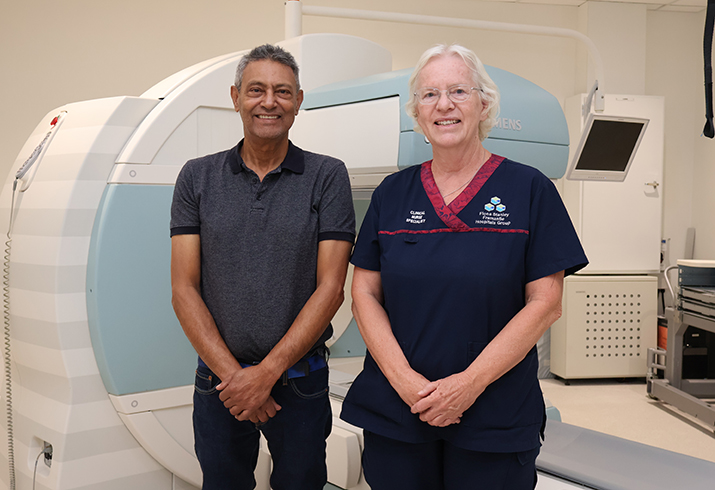
Urology patient and clinical nurse specialist in a clinical imaging room, standing in front of a large medical scanner.  Fiona Stanley Hospital patient, Trevor Van Dyk, with Clinical Nurse Specialist, Urology, Cynthia Hawks.
02/11/2026

South Metropolitan Health Service (SMHS) researchers are building on the success of a world-first bladder cancer trial, with a new study providing further insight into how immunotherapy could be delivered directly to where it is needed.

In 2024, the SUBDUE -1 trial showed it was safe and feasible to inject the immunotherapy drug durvalumab directly into the bladder wall.

Now, the follow-on SUBDUE-3 study is investigating where the drug travels after injection and how much remains in the bladder compared with other areas of the body.

For the world-first study, durvalumab was specially radiolabelled, allowing researchers to track the drug using PET scans.

Early findings show a large amount of the drug remains in the bladder wall, with far less than expected travelling to other areas. Researchers also observed the drug travelling to regional lymph nodes.

SMHS Head of Urology Dickon Hayne said the findings could help researchers explore more targeted approaches to treatment.

“What we’ve found is that a large amount of the drug stays in the bladder wall, while far less than expected travels to other parts of the body. Importantly, we’ve also seen the drug travel to the regional lymph nodes.

“This suggests we may be able to use less drug while delivering a much higher dose directly to where it is needed. The longer-term goal is to explore whether this approach could provide more targeted treatment for bladder cancer while reducing side effects elsewhere in the body.”

For SMHS patient Trevor, joining SUBDUE-3 was another step in a bladder cancer journey that began four years ago.

After undergoing several treatments, including chemotherapy, Trevor received immunotherapy directly into his bladder as part of the study and underwent PET scans to help researchers track the drug.

Trevor experienced little pain or side effects during the study and praised the support he received from the Fiona Stanley Hospital team.

“Taking part in the trial has just been part of the process for me. I’ve had a positive experience at Fiona Stanley Hospital and found the care and support from the team even better than my experience in the private healthcare system. “Trevor said.

“Hopefully, by being involved, I can help others have a better quality of life in the future,”

While Trevor has a road to go on his treatment journey, he’s able to do the things he loves.

“When I’m not at the hospital I’m just relaxing, practicing my golf shots and riding my motorbike,” he said.

SUBDUE-3 is a collaborative investigator-initiated trial involving AstraZeneca, the Olivia Newton-John Cancer Research Institute and ANZUP, with funding provided by ANZUP and AstraZeneca.


Keep up to date with our news and achievements

Find out more on Facebook (external site) or LinkedIn (external site)


Previous Next
Last Updated: 02/11/2026
  • Facebook
  • LinkedIn

Footer menu

  • wa.gov.au
  • Copyright
  • Disclaimer
  • Privacy
  • Sitemap
  • Contact Us

Brought to you by the Department of Health, Western Australia

© Government of Western Australia 2018 to